Last Updated on 2026-03-07
When I taste wine, I like to break it down into several key dimensions. Each wine sits somewhere on a spectrum — from low to high, light to powerful. By placing a wine along these spectrums, we can clearly understand its personality.
Below are the main characteristics I use when evaluating wine.
1. Sweetness
Sweetness describes how much residual sugar remains in the wine.
The spectrum usually looks like this:
Dry → Off-dry → Sweet → Dessert wine
The wines I enjoy sit very close to the dry end of the spectrum.
This means they contain little to no sugar and feel crisp rather than sweet.
Dry wines allow the other elements of wine — tannin, acidity, structure, and flavor — to stand out more clearly.
2. Tannin
Tannins are natural compounds extracted from grape skins, seeds, and oak barrels.
They create that drying sensation in your mouth, similar to strong black tea.
The spectrum:
Low tannin → Medium tannin → High tannin
The wines I prefer tend to have medium-high to high tannins.
High tannin wines usually:
• feel more structured
• pair well with meat
• age well over time
This is why many powerful red wines improve after several years of aging.
3. Acidity
Acidity is what gives wine its freshness and brightness.
Low-acidity wines feel round and soft.
High-acidity wines feel sharp and lively.
The spectrum:
Low acidity → Medium acidity → High acidity
My preference sits around low to medium acidity.
I tend to enjoy wines that feel smooth and round rather than sharp or sour.
4. Body
Body describes the weight or richness of the wine in your mouth.
Think of it like milk:
• skim milk → light body
• whole milk → medium body
• cream → full body
The wines I enjoy are clearly full-bodied.
Full-bodied wines feel rich, dense, and powerful.
5. Alcohol
Alcohol also influences the body and warmth.
Most wines fall between:
8% → 16%
My preference is toward the higher end of the spectrum, usually around:
13.5% – 15.5%
Higher alcohol wines often feel bolder and more intense.
6. Flavor Intensity
Some wines are subtle and delicate.
Others are bold and explosive.
The spectrum:
Light flavors → Medium → Intense
The wines I enjoy are clearly high intensity.
Typical flavor notes I like include:
• blackberry
• black pepper
• dark chocolate
• smoke
• oak/wood
These flavors are typical of powerful red wines.
7. Complexity
Complexity refers to the number of layers of aroma and flavor a wine has.
Simple wines usually have one or two dominant notes.
Complex wines evolve as you smell and taste them.
You might notice:
• fruit
• spice
• earth
• oak
• leather
• chocolate
The wines I prefer tend to be complex, revealing new layers over time.
8. Finish
The finish is how long the flavor remains after swallowing.
Short finish: disappears quickly
Medium finish: lingers briefly
Long finish: stays in your mouth for a long time
High-quality wines usually have a long finish, which is something I strongly enjoy.
My Wine Taste Profile (Summary)
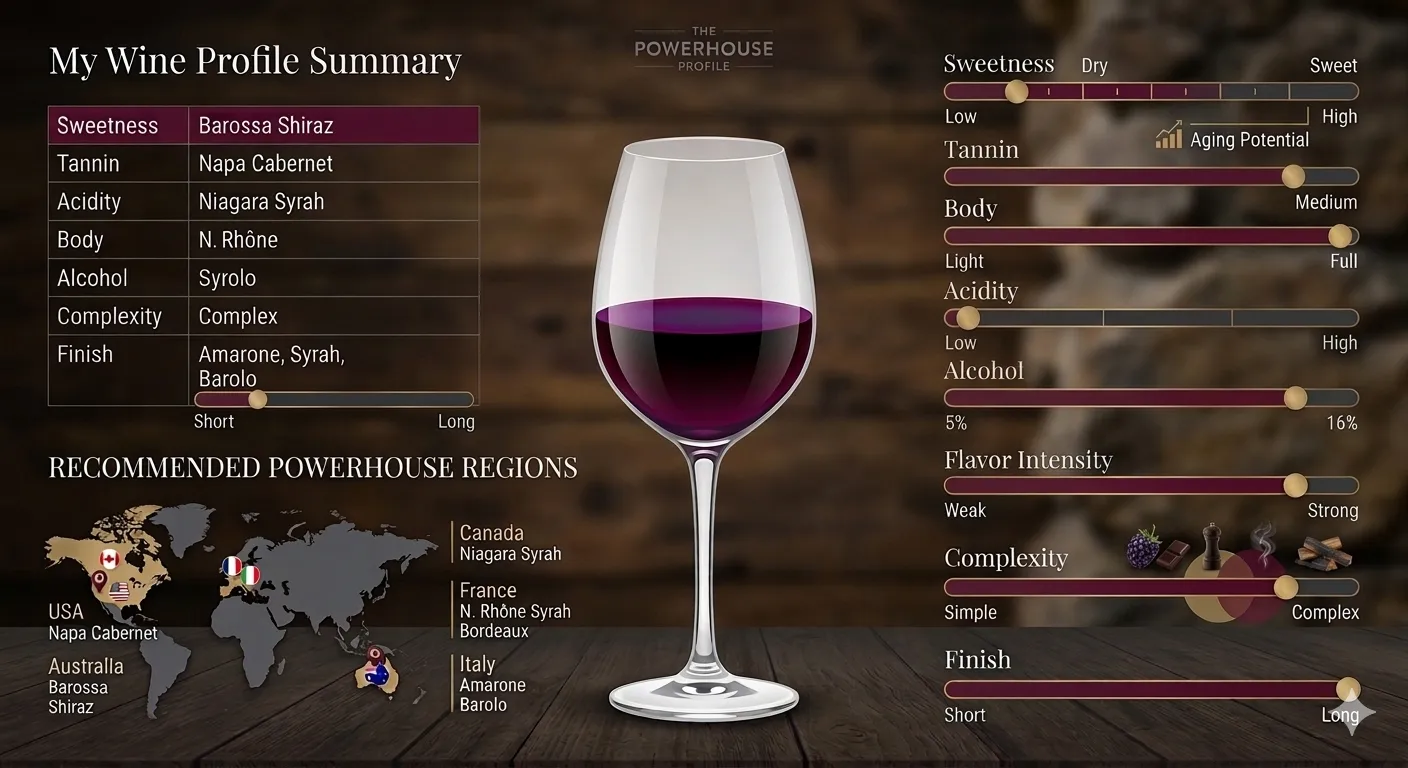
Putting all these characteristics together, my taste profile looks like this:
| Characteristic | Preference |
|---|---|
| Sweetness | Dry |
| Tannin | Medium-High to High |
| Acidity | Low to Medium |
| Body | Full |
| Alcohol | Medium-High to High |
| Flavor Intensity | Strong |
| Complexity | High |
| Finish | Long |
In simple terms:
I enjoy bold, powerful, full-bodied red wines with deep flavors and structure.
Wines That Match This Profile
Based on this taste profile, several famous wine styles fit very well.
Australia
Australia produces some of the most powerful wines in the world.
Best matches:
Barossa Valley Shiraz
Very bold, high alcohol, dark fruit, pepper, and chocolate.
McLaren Vale Shiraz
Rich, full body, smooth tannins.
Coonawarra Cabernet Sauvignon
Blackcurrant, mint, strong structure.
United States
California is known for big, full-bodied wines.
Best matches:
Napa Valley Cabernet Sauvignon
Blackberry, cassis, oak, long finish.
Paso Robles Syrah
Pepper, dark fruit, smoky notes.
Zinfandel (Old Vine)
Very bold, spicy, high alcohol.
Canada
Canada also produces some interesting, bold reds.
Best matches:
Niagara Cabernet Sauvignon
Dark fruit, medium-high tannin.
Niagara Syrah
Pepper, blackberry, smoky notes.
Niagara Cabernet Franc
Spice, structure, medium-full body.
France
France tends to be more balanced but still produces powerful wines.
Best matches:
Northern Rhône – Syrah (Hermitage, Côte-Rôtie)
Black pepper, dark fruit, smoky, complex.
Bordeaux (Left Bank)
Cabernet-dominant wines with strong tannin and aging potential.
Châteauneuf-du-Pape
Rich, spicy, powerful.
Italy
Italy also offers structured and powerful wines.
Best matches:
Amarone della Valpolicella
Very rich, high alcohol, intense flavors.
Barolo (Nebbiolo)
Very high tannin, complex, long aging.
Brunello di Montalcino
Full body, powerful structure.
Final Thought
If we simplify everything:
The wines that best match my taste profile are typically:
• Shiraz / Syrah
• Cabernet Sauvignon
• Amarone
• Barolo
• Brunello
These wines share the same characteristics:
bold structure, deep flavors, high complexity, and long finishes.
They sit on the powerful end of the wine spectrum — exactly where my preferences lie. 🍷